
A Comprehensive History of Richardson, Texas
By: Lisa C. Maxwell
Revised by: Steven R. Butler
Published: 1952
Updated: June 1, 2023
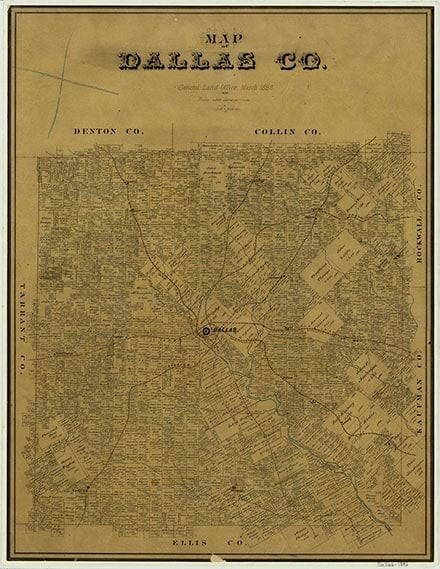
Richardson, one of the largest small cities in Texas, is located about fourteen miles north of downtown Dallas on Central Expressway (U.S. Highway 75). The Red Line of the DART (Dallas Area Rapid Transit) light rail system parallels the highway. The majority of Richardson is located in northern Dallas County with a smaller portion in southern Collin County. Encompassing slightly more than twenty-eight-square-miles, Richardson has an irregular shape, bounded on the west, northwest, and south by Dallas, by Garland on the east and south, by Plano and Murphy on the north, and Sachse on the east. Several small streams, most notably Prairie, Spring, Duck, and Cottonwood creeks, flow through the city.
Between 1841 and 1853 the land that makes up Richardson was part of the Peters Colony. In 1858 a small forerunner settlement, called Breckinridge in honor of U. S. vice president John C. Breckinridge, was established on land belonging to settler John B. Floyd, between present-day Richland College and Restland Memorial Park. Breckinridge, which consisted of a U. S. post office, a general store, a blacksmith shop, and an inn, was served by a Sawyer, Risher, and Hall stagecoach line (see RISHER AND HALL STAGE LINES). The settlement lasted until just after 1873, when the Houston and Texas Central (H&TC) Railroad bypassed it in favor of a new town, named in honor of H&TC secretary Alfred Stephen Richardson. For nominal sums, two local landowners, William J. Wheeler and Bernard Reilly, sold a combined 101 acres of land for the townsite in April 1873, but due to a deed record error, the first and subsequent maps of the town showed its size as 121 acres. Some sources have claimed that Wheeler refused to allow the town to be named for him, but this story is apocryphal. On June 23, 1873, the railroad trustees who purchased the townsite on the railroad’s behalf dedicated a right-of-way through Richardson to the H&TC. The following year they sold the townsite to the railroad for the same price they had paid for the land. Soon after, the first town lot was sold. That same year, a school called the Patrons Institute, also known as the Wheeler School, was built just outside the town limits.
During its first quarter century, Richardson grew slowly. Its business district consisted of one block adjacent to the railroad tracks and one block of Smith Street, the town’s principal thoroughfare, now known as East Main Street. Richardson received a post office in 1874. In 1901, when drugstore operator Sam P. Harben launched the town’s third and longest-running newspaper, the Richardson Echo, replacing the short-lived Richardson Register, there were only six businesses. Two were housed in brick buildings; the remainder in wood frame structures. The population at that time was under 150 people. Most of the Echo’s first subscribers were area farmers who, following the Civil War, favored the cultivation of cotton over wheat, which before the war had been the area’s principal crop.
After the turn of the twentieth century, the town began to experience a much faster rate of growth, especially after 1908, when the Texas Traction Company’s electric interurban railway, which connected Richardson to Dallas, Denison, and other points in North Texas, arrived. Its tracks ran parallel to those of the H&TC. Richardson had a population of 147 in 1904, but by 1925 it had more than doubled to 400. In 1900 the Richardson Independent School District (RISD) was established and built a new school to replace a previous structure that burned earlier that year, and in 1914 a larger, red brick schoolhouse, which subsequently served as the RISD’s administration building, was constructed.
In 1901 the Richardson Telephone Company was incorporated, and in 1904 the Citizens State Bank, the town’s first financial institution, was opened. About 1907 a hotel was built, and in 1909, the same year in which the streets were graveled, developers began selling lots in the town’s first addition, called North Richardson. Three years later the Wilcox Light & Power Company constructed the town’s first electric power plant, which allowed the building of an electric cotton gin to replace an earlier steam-powered gin, which had been destroyed by fire.
Throughout this period, community football and baseball teams competed with teams from Dallas and other small towns. In 1914 a thirty-piece concert band was formed, which performed regularly in Richardson and by request in nearby communities. Both the band and a women’s group called the Blue Bonnet Club temporarily suspended their activities during World War I, with many of the men going off to war and the women assisting the American Red Cross. Following the war Richardson continued to grow in size and population, with developers selling residential lots in the new Walton Place and Pittman-Stults additions.
In 1922 the first Richardson Community Fair, one of the town’s longest-lasting local institutions, was held, largely to promote interest in agriculture and livestock. Features like a midway, together with a variety of exhibits and entertainment, helped attract visitors from Dallas and other nearby towns. In 1923 the fair was preceded by a Ku Klux Klan parade which reportedly attracted a crowd of 5,000 people. In spring 1924 a tornado killed one person, injured thirteen others, and destroyed a large amount of property. The storm bypassed the city center. That same year the Richardson Pike, present-day Greenville Avenue, which connected the city to Dallas, was paved with red bricks, which led to increased automobile traffic to Richardson.
On June 22, 1925, Richardson incorporated, and voters elected Tom McKamy as the city’s first mayor under a commission form of government. The community continued its improvements with a public waterworks, complete with a deep artesian well, water tower, and sanitary sewers. In 1926 a volunteer fire department was formed. The following year the Richardson and Addison High schools were consolidated, with all the students attending school in Richardson.
The population of Richardson continued to slowly rise from 400 before the Great Depression to 720 shortly before World War II, by which time the city had many more businesses, including an indoor movie theater on Main Street. In the late 1940s all the city streets were paved. Despite this growth and development, for a quarter century following incorporation Richardson remained an agricultural community with a small-town appearance and character. After World War II Richardson underwent a period of rapid development that was largely due to the arrival of two major electronics firms, Collins Radio and Texas Instruments (the latter of which built a large campus adjacent to the city limits), and the extension of Central Expressway through the city in 1954.
In 1952, at the beginning of the postwar boom, Richardson had a population of 1,288. By 1960 the population had dramatically increased to 16,810, as new businesses attracted a better-educated workforce. Within a short period of time, modern shopping centers and new residential additions, such as Richardson Heights, rapidly replaced the cotton fields as Richardson became an affluent suburb of Dallas. A larger, more affluent population also led to a rise in tax revenues, which allowed the city to form a police department; expand the fire department; and build a new city hall, new post office, and new library. Parks, playgrounds, recreation centers, and public swimming pools were also provided as the city began to likewise expand in physical size by annexing previously unincorporated land outside the original city limits. This rapid growth and change led the Dallas Morning News to dub the city “Remarkable Richardson.”
In 1956 Richardson voters approved a home rule charter and a council-manager form of city government. New zoning laws created industrial parks that attracted several manufacturing businesses, which provided jobs for the city’s ever-increasing population, which by 1970 had grown to 43,900. One of the largest and most popular locally-owned businesses was the Owens Country Sausage Company, which in 1978 began offering daily public tours of its Spring Creek Farm facility.
By the late 1960s the Richardson Independent School District, which had once housed all grades in a single building, included seventeen elementary schools, five junior high schools, and three senior high schools. In 1965 all the schools were desegregated. The previous year the Graduate Research Center of the Southwest opened on land that was later annexed to Richardson. In 1969 it became the University of Texas at Dallas. In 1972 Richland College, a Dallas County Community College District campus, was built just south of the city.
In 1980 the city had 12 banks, 400 restaurants, and 16 religious denominations, most of them Protestant Christian. RISD (which includes part of Dallas and Garland) then operated fifty schools, with a student population of 32,695. Richardson also had its own symphony orchestra. The annual Christmas Parade was a popular event. In 1989 the city of Richardson also began hosting a seasonal “Santa’s Village” adjacent to the new city hall, opened in 1980.
During the 1980s Richardson experienced a second boom when several telecommunication firms, including MCI Communications (now Verizon), opened facilities in the city, most within a mile of Central Expressway. For that reason, Richardson became known as the “Telecom Corridor.” Richardson Square Mall opened in 1977, thrived in the 1980s, but began to decline in the 1990s. In 2007 it was demolished and replaced by stand-alone retail businesses. In 1992 Richardson opened Breckinridge Park, the city’s largest park, in northeastern Richardson, where the city of Richardson holds an annual Independence Day fireworks display.
By 1990 Richardson boasted no fewer than 102 manufacturing firms, largely focused on electronics and telecommunications. The only news publication was the Richardson News, a weekly newspaper founded in 1958 that purchased the Richardson Echo in 1964. It ceased publication in 2000. In 1993 the city of Richardson began holding its annual Wildflower Arts & Music Festival, and in 1994, on a wooded tract that once belonged to one of the area’s early settlers, the city opened the Spring Creek Nature Area.
In 1990 Richardson’s population was 74,840. Ten years later the population was 91,802; by 2020 it had increased to nearly 120,000. Since 1980, when the city was 95 percent White, the racial and religious makeup of Richardson has changed dramatically. By 2020 the population was 50 percent non-Hispanic White, 10 percent non-Hispanic Black, 17 percent Hispanic, and 17 percent Asian. A former shopping center near old downtown Richardson, which became known as DFW China Town, is at the heart of the city’s large Asian community. In addition to several Protestant Christian churches, there are Roman Catholic, Jewish, Buddhist, and Sikh congregations in the city. Richardson’s Islamic Association of North Texas mosque is one of the largest mosques in Texas.
During the early twenty-first century Richardson residents saw a number of new developments and improvements. In 2002 the Dallas Area Rapid Transit (DART) system’s Red Line reached Richardson, and three DART stations were opened in the city. That same year the Eisemann Center for the Performing Arts opened. In 2011 the Glenville hike and bike trail was completed, and in 2014 an additional fifty-seven acres of woodland were purchased and added to the Spring Creek Nature Area.
Richardson has had its share of famous residents. One of the most noteworthy was Marina Oswald, widow of John F. Kennedy assassin Lee Harvey Oswald (see KENNEDY ASSASSINATION), who moved to Richardson, where she married her second husband in 1965. Acclaimed fiction author Anne Rice and televangelist Robert Tilton were both graduates of Richardson High School, where in 1991 a student’s suicide inspired a hit single by the grunge-rock band Pearl Jam. Singer Jessica Simpson was a student at J. J. Pearce High School in Richardson when she first came to national attention. Lyrick Studios, which created beloved children’s television show characters, Barney the purple dinosaur and Wishbone the dog, were based in Richardson.
Bibliography:
Barbara Braithwaite, comp., A History of Richardson (Richardson, Texas: Richardson Historical Society, 1973). Steven R. Butler, A Sesquicentennial History of Richardson (Richardson, Texas: Poor Scholar Publications, 2022 and 2023). Dallas Morning News, March 26, 1967. Historical Marker Files, Texas Historical Commission, Austin. Richardson Echo, February 17, 1965.
The following, adapted from the Chicago Manual of Style, 15th edition, is the preferred citation for this entry.
Lisa C. Maxwell Revised by Steven R. Butler, “Richardson, TX,” Handbook of Texas Online, accessed April 11, 2026, https://www.tshaonline.org/handbook/entries/richardson-tx.
TID:
HDR01
All copyrighted materials included within the Handbook of Texas Online are in accordance with Title 17 U.S.C. Section 107 related to Copyright and “Fair Use” for Non-Profit educational institutions, which permits the Texas State Historical Association (TSHA), to utilize copyrighted materials to further scholarship, education, and inform the public. The TSHA makes every effort to conform to the principles of fair use and to comply with copyright law.
For more information go to: http://www.law.cornell.edu/uscode/17/107.shtml
If you wish to use copyrighted material from this site for purposes of your own that go beyond fair use, you must obtain permission from the copyright owner.
- 1952
- June 1, 2023
This entry belongs to the following special projects:

Is history important to you?
We need your Support because we are a non-profit that relies upon contributions from our community in order to record and preserve the history of our state. Every dollar helps.
I Want to Help Support the Preservation of Texas History→




Share this entry on social media: